The Customer Who No Longer Trusts You
Trust now sits level with price and quality as a reason people buy, and the machines standing between companies and their customers are eroding it.
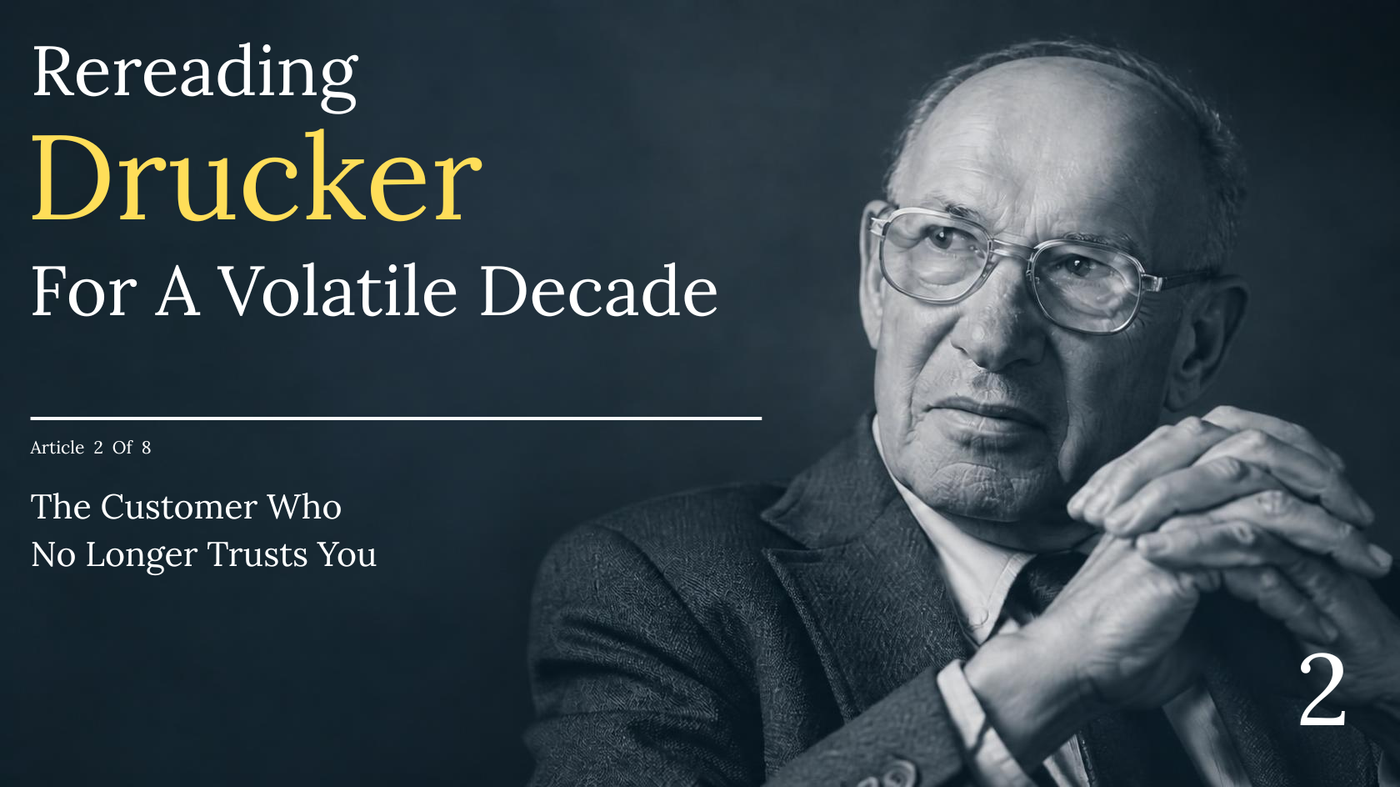
Drucker gave us the cleanest sentence ever written about business: its purpose is to create a customer. He did not tell us what to do when the customer shows up already certain you're lying to them.
That is the first clause of the contract, and the one that fails first.
Start with what Drucker actually said, because it's usually quoted at half its depth. There is only one valid definition of business purpose, he wrote: to create a customer. Marketing and innovation produce results; everything else is a cost. That much gets repeated. The part that gets dropped is the harder half — that the customer, not the company, decides what the business is. The customer rarely buys what the firm believes it is selling. What the customer considers value is the only thing that is decisive. Value is defined from the outside in, and the whole job of the enterprise is to find out what the customer values and organize itself around the answer.
So Drucker handed us a sovereign customer seventy years ago. What has changed is not the sovereignty. It is what the customer values, and whether you ever get to meet them.
Take the first. When Drucker wrote, "what the customer values" meant the product, the price, the service around it. Those still matter. But something has climbed into the equation beside them. Edelman now finds that trust has risen to sit level with price and quality as a reason people buy — and that only about a third of consumers say they trust most of the brands they actually purchase. The gap between buying and trusting is the whole story. And when a brand is trusted not only on its product but on its customer service and how it behaves in the world, the share of people who will buy first, stay loyal, advocate and defend runs well ahead of a brand trusted on product alone. The customer is now buying your conduct bundled with your goods. A company that optimizes the product and ignores the conduct is, in Drucker's own terms, selling something other than what the customer is buying — and then wondering why loyalty won't hold.
Now the second change, the one Drucker could not have seen. Increasingly you never meet the customer at all. A machine stands in the doorway — the search ranking, the recommendation engine, the chatbot, the service queue that never reaches a person. That intermediary was sold to us as intimacy at scale. It is manufacturing suspicion instead. More than half of consumers say they distrust the AI-generated answers they are now served, and a majority want the ability to switch the machine off. Most say they would consider leaving a company that replaced its human support with AI — people don't mind a chatbot until it becomes the only door. And beneath the annoyance sits something colder: the suspicion that the machine is optimizing against them. Seventy-one percent of Americans believe the growing use of AI will make their personal information less secure. More than half have begun actively avoiding the recommendations, chat tools and personalization features companies spent fortunes building. Three-quarters say they will not buy from a company they don't trust with their data.
Here is the Druckerian irony in it. The more precisely you target and personalize, the more the customer feels surveilled rather than served. Past a certain point, optimization reads as manipulation. You can win the algorithm and lose the customer — and most companies are counting the wrong one.
You can win the algorithm and lose the customer — and most companies are counting the wrong one.
So what does "create a customer" mean now?
It means earning trust before you earn the sale, because suspicion is the default setting, not a fault you occasionally trip. Creating a customer is no longer a conquest you complete once. It is a relationship you re-earn continuously, and the customer can tear up the contract with one tap and never tell you why.
It means accepting that "what the customer values" has expanded to include how you behave: whether you are honest about what the product does, whether the machine between you serves the customer or fleeces them, whether you treat what you know about them as theirs, held in trust rather than harvested. That is not corporate social responsibility bolted onto the side. It is now part of the product — something you build into the offer or fail to.
And it means remembering, in a world of intermediation, where trust is actually held. The clearest signal in all of this is that people will leave a company for taking the human option away — which tells you the human touchpoint is not a cost center but the place the relationship lives. The company that automates away its last point of human contact in the name of efficiency is optimizing away the one asset that rebuilds trust. Efficiency that costs you the customer's trust is not efficiency. It is liquidation on a slow timer.
None of this is a departure from Drucker. It is Drucker held to his own standard. He told us to find out what the customer values and build the business around it. The customer has simply told us what they value now: to be dealt with honestly, by a company that can still be reached, that treats what it knows about them with respect. The definition of value grew. The discipline is unchanged.
The purpose of a business is to create a customer — and then, in a low-trust age, to keep proving worthy of one. That is the first clause, and the customer is the party who signed it last and walks away first, quietly, the moment it is broken.
But the customer is not the only one now working alongside the machine. The next clause turns inward — to the person Drucker bet the whole future on, the knowledge worker, and to the question that arrives the day the machine can do the work.
Sources and further reading
- Peter F. Drucker, The Practice of Management (1954) — "there is only one valid definition of business purpose: to create a customer."
- Edelman 2025 Trust Barometer Special Report: Brand Trust, From We to Me. Special report
- Gartner consumer survey (September 2025) on trust in AI search and human support. Gartner newsroom
- Pew Research Center (2026) — 71% of U.S. adults believe increased use of AI will make personal information less secure.
- Cisco 2024 Consumer Privacy Survey — avoidance of AI-powered features; purchase decisions and data trust.