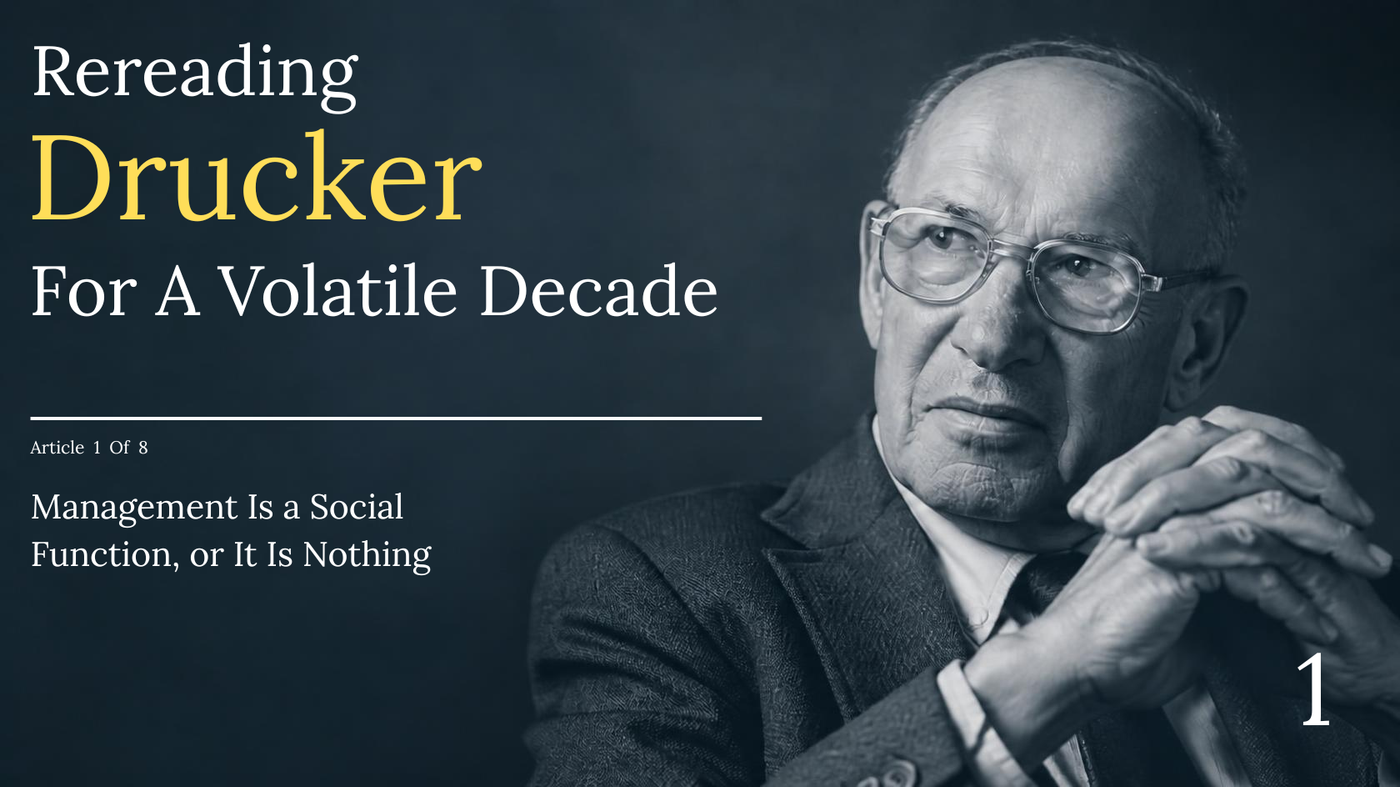
Management Is a Social Function, or It Is Nothing
We have never managed more precisely, or been trusted less. That is not a coincidence.
The tools have never been sharper. We measure what used to be unmeasurable, forecast what used to be guesswork, and run global organizations from a dashboard. And yet the institutions those tools serve are trusted less than at almost any point in living memory. The reflex in most boardrooms is to treat this as a reputation problem — a matter for communications, for brand, for a better narrative. I want to argue the opposite. It is a management problem. And Peter Drucker, of all people, told us why more than seventy years ago.
We have forgotten where Drucker came from. Before he was the man in the business magazines, he was a political and social thinker preoccupied with a single question: after the old structures of community had dissolved, where would a modern person find function, status, and dignity? His answer was the organization — and management was the thing that made the organization work. Management, in other words, was never a business technique that happened to carry social consequences. It was a social function first. Society grants the organization something extraordinary — legal standing, capital, talent, the license to operate — and in return expects it to perform: to create value, to make human strength productive, to give people a place to contribute. That exchange is a contract. Management is the party that signs it on the organization's behalf.
And here is the clause we find easiest to skip. Drucker held that management's authority — its power over people's working lives — is legitimate only so long as it performs that social function. Not because it is profitable. Not because it owns the assets. Because it delivers on the contract. Legitimacy was always conditional.
Over the decades that followed, we quietly rewrote the terms.
Management professionalized into something admirable and dangerous: a portable optimization technology, a set of transferable skills you could aim at any problem in any sector. That was a genuine achievement. It was also the beginning of the forgetting, because a technique has no purpose of its own — it does whatever it is pointed at. Then shareholder primacy supplied the aim. The organization was recast as a machine for producing returns, and the social function — the whole reason management existed in Drucker's telling — was demoted to a department. We called it corporate social responsibility, gave it a report and a budget line, and treated it as something to attend to once the real work was done. The contract wasn't torn up. It was filed under nice-to-have.
The other parties to the contract have noticed. This is what the trust data is actually telling us, if we read it as more than a PR scorecard. Among people whose confidence has been shaken by recent events, net trust in the leaders of national governments has fallen by sixteen points and in major news organizations by eleven. People are withdrawing their trust from distant institutions across the board. The premise the Drucker Institute names plainly — that organizations are the load-bearing walls of a functioning society — is now openly contested, precisely because too many of them have been run as though it were not true.
And the timing could hardly be worse, because two forces are compounding. The tools kept growing more powerful and more opaque — more scale, more algorithm, more AI — which reads, to a public that already doubts your intentions, as threat rather than progress. Sophistication without legitimacy doesn't reassure; it frightens. Meanwhile, the people we rely on to honor the contract day to day are themselves breaking down. Global employee engagement has slipped to 20 percent, down from 21 the year before and a peak of 23 in 2022 — the first back-to-back annual decline since Gallup began tracking it. The slide is being driven not by the front line but by managers, whose engagement fell to 22 percent in 2025, down from 27 a year earlier, while individual contributors barely moved. The stewards of the contract are exhausted and checked out. You cannot keep a promise you no longer have the energy to make. Gallup puts the cost of all this disengagement at roughly $10 trillion in lost productivity — about 9 percent of global GDP.
So what follows, if we take Drucker seriously?
First, that trust cannot be communicated back into existence. It is the visible residue of an organization performing its social function, and it can only be rebuilt the way it was lost: through management. No campaign survives contact with a workforce that knows better. You cannot message your way out of a management failure.
Second — and this is the line I would ask every leader to sit with — effectiveness and legitimacy are not two goals to be balanced against each other. Properly understood, they are the same thing. An organization that does not perform its social function is not "successful but a little cold." It is failing at its actual purpose, and the bill always arrives: through the talent that won't join, the customers who defect the moment they have an alternative, the regulator who stops extending the benefit of the doubt. Legitimacy is not a tax on performance. It is performance, measured over a longer horizon.
Third, and most hopeful: the ground has not been lost everywhere. The same research that shows trust collapsing at a distance shows it holding, even rising, up close. Trust in coworkers and in one's immediate circle has risen by eleven points, employees' trust in their own CEO by nine, and employers are now seen as the institution best able to bridge divides. Read that again, because it is the whole opportunity. The one place trust still lives is the immediate working relationship — which is exactly the terrain management occupies. Of all the institutions trying to win back a skeptical public, the well-run organization is standing closest to the thing everyone else is chasing.
Legitimacy is not a tax on performance. It is performance, measured over a longer horizon.
That turns the abstraction into work. Treat trust as a managed asset with leading indicators, not a lagging sentiment you survey once a year. Run consequential decisions through one question before you make them — does this strengthen or spend our legitimacy? — and mean it enough to sometimes take the harder path. And rebuild the visible line between a person's work and its contribution: function, status, dignity, the very things Drucker said the organization existed to provide, and the very things a disengaged workforce is telling us it no longer feels. That last one is not soft. It is the antidote to the most expensive problem most organizations have.
Management is a social function — or it is a very good engine bolted to hollow ends. That is the choice in front of leaders now, and the volatility of the moment does not excuse the choice; it sharpens it. The contract between organizations and the society that permits them has been broken slowly, over a long time. It can be repaired the same way: deliberately, through how we actually manage.
Everything else in this series is another clause of the same contract, read in the light of what the present has broken. Different questions, one contract. And the Drucker Institute frames its purpose as a single question, the right one to build toward: what must be done to make our organizations effective and our society stronger?
The answer begins by remembering that those were never two separate things.
Sources and further reading
- Peter F. Drucker, The Future of Industrial Man (1942) — the functioning society; the individual's need for status and function; legitimate authority.
- Peter F. Drucker, Concept of the Corporation (1946) — the corporation as a social institution, not merely an economic one.
- Peter F. Drucker, The New Society (1950) — the society of organizations, and management's role within it.
- Peter F. Drucker, Management: Tasks, Responsibilities, Practices (1973) — social impacts and social responsibilities; the legitimacy of management.
- Peter F. Drucker, A Functioning Society (2002, collected writings).
- Edelman Trust Barometer 2026, Trust Amid Insularity. 33,938 respondents across 28 countries. edelman.com/trust/2026
- Gallup, State of the Global Workplace: 2026 Report. State of the Global Workplace