The Restructuring Reflex: Why Executives Reach for the Org Chart When the Problem Is Somewhere Else
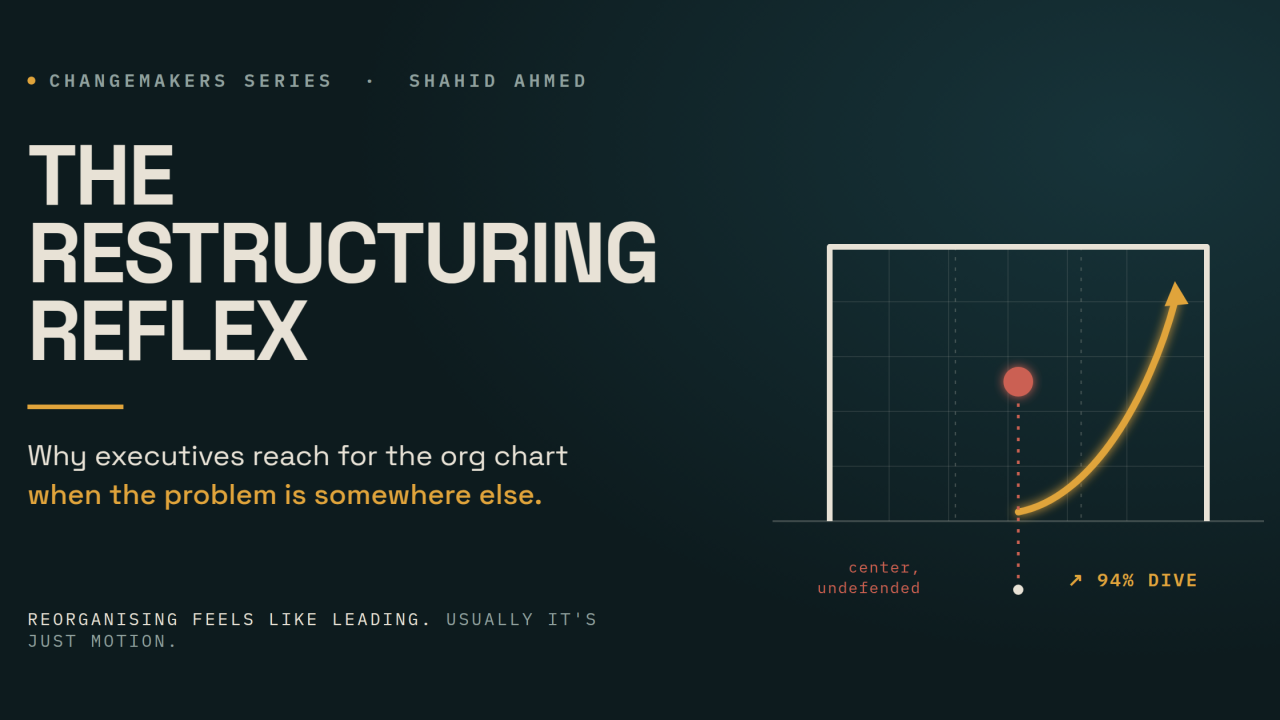
When a striker steps up to take a penalty kick, the goalkeeper almost always dives - left or right, committed and airborne before the ball is struck. It looks like the only reasonable thing to do. And yet the data on penalty kicks shows that keepers who simply stay in the center of the goal stop more shots than those who dive. So why do they keep diving?
Because standing still, in the moment when everyone is watching and a goal is about to be conceded, feels like doing nothing. And doing nothing feels like failure. Diving - even in the wrong direction - at least looks like effort.
Behavioral scientists call this action bias. And it is the single most useful lens I know for understanding one of the most expensive habits in corporate life: the reflex to reorganize.
Performance dips. A competitor pulls ahead. The board wants to know what leadership is going to do about it. And the fastest, most visible way to demonstrate that you are doing something is to redraw the organization chart. New boxes. New reporting lines. New titles. A town hall, a slide deck, a fresh sense of momentum.
The problem is that the org chart is almost never where the real problem lives.
The Reflex, by the Numbers
Reorganizing is no longer an occasional event. It has become the ambient condition of corporate life.
In one McKinsey survey, 82% of executives said they had experienced an organizational redesign at their current company, and 70% said the most recent one had happened within the previous two years. A majority expected another within two years after that. Companies now revamp their organizations more often than they overhaul their websites - every three years or so - or upgrade their computer systems, every three to five.
Gartner calls change "the new constant," reporting that the typical organization ran five enterprise-wide changes in three years - a cadence so relentless that no single structure ever gets the chance to prove whether it works before the next one replaces it.
Sit with that for a moment. If you restructure every eighteen to twenty-four months, you have guaranteed that you will never actually know whether your last structure was the problem. You've made it impossible to run the experiment. Every reorg becomes the justification for the next one.
Why It Keeps Failing
If reorganizing worked, its frequency wouldn't matter. But the evidence on outcomes is sobering, and it has been consistent for well over a decade.
McKinsey research behind Harvard Business Review's "Getting Reorgs Right" found that more than 80% of reorganizations fail to deliver the value they were supposed to in the time planned, and 10% cause real damage to the company. To be fair, two-thirds deliver some performance improvement - reorgs are not worthless. But "some improvement, most of the time, eventually" is a very long way from the decisive fix leaders imagine they're authorizing.
The foundational study is even more pointed. In "The Decision-Driven Organization," Bain & Company examined 57 reorganizations and found that fewer than one-third produced any significant improvement in performance - and some destroyed value outright. Their conclusion was not that companies chose the wrong structures. It was that structure itself is rarely the lever people think it is.
Then there is the human cost, which leaders systematically underestimate. Reorgs - and the uncertainty they unleash about who will have a job, a boss, or a future - can generate more stress and anxiety than layoffs, and productivity falls in roughly 60% of cases. A typical reorganization takes about ten months from plan to practice, which means the organization spends the better part of a year distracted, anxious, and internally focused - precisely when it claims to be responding to an external threat.
Here is the most revealing finding of all. In 2026 research, Bain found that 88% of company leaders believed their new structure would achieve its goals - while only 36% of the employees actually working in that structure agreed. That fifty-two-point gap is the reflex in miniature. The people drawing the boxes are confident. The people living inside them already know it won't work. And leadership almost never hears the difference until the results come in.
Why the Reflex Fires
If reorganizing so rarely delivers, why is it the go-to move? Three forces converge, and none of them is strategy.
The first is action bias itself. The impulse to act - to do something - intensifies precisely when we feel out of control and when others expect us to respond. A reorg is the most legible possible display of leadership. It produces artifacts: a new chart, a new leadership team, an announcement. As one sharp analysis put it, the reorg satisfies the board because action was visibly taken. Motion gets mistaken for progress.
The second is authorship. New leaders reorganize to signal a new chapter - to put their fingerprints on the enterprise and assemble a team loyal to their vision. Bain found that nearly half of all CEOs reorganize their companies within their first two years on the job. And there have never been more new leaders reaching for the pen: average CEO tenure fell to 8.5 years in 2025, a record 168 new CEOs were appointed across the S&P 1500, and 84% of them were first-timers, according to Spencer Stuart. More new leaders, on shorter clocks, under more scrutiny, equals more reflexive restructuring - often before anyone has diagnosed what's actually wrong.
The third is the quiet appeal of the euphemism. "Restructuring," "rightsizing," "realignment" - this vocabulary converts hard, accountable choices into structural adjustments that seem to have no author. It is easier to redraw a chart than to confront an underperforming executive, a broken incentive, or a strategy nobody believes in. The reorg launders difficult decisions into the neutral language of organizational design.
The Org Chart Is Not the Constraint
Here is the uncomfortable core of it. Most of the problems that trigger a reorg do not live in the boxes. They live in the white space between the boxes.
As the organizational design specialists at Lotis Blue observe, leaders love to change the boxes and lines at the top - which are mostly about power and reporting - while overlooking the white space where the real problem usually resides: governance and decision rights, roles and responsibilities, the interfaces between teams, the actual workflows, and whether people have the capability to do the work. You can redraw every box on the chart and change none of that.
This was Bain's original insight, and it still holds: a structure only improves performance if it helps the organization make and execute key decisions faster and better than competitors. Absent that, you have rearranged the furniture. Gallup's research makes the same point from a different angle - that operating-model diagnostics tend to fix the easily fixable symptoms while carefully avoiding the harder questions of decision rights and incentive architecture.
And even when the new structure is genuinely better on paper, it changes nothing if behavior stays the same. Reorganization without cultural change, as one advisory bluntly framed it, delivers nothing but a new org chart: people adopt the new labels while preserving the old logic, because the rituals, the meeting architecture, and the unwritten rules about who really decides haven't moved an inch. Readers of this series will recognize the pattern - it is transformation theater wearing a new organizational costume.
So before you redraw anything, the essential question is diagnostic, not structural. Is the problem structural or behavioral? Structural problems are persistent, systemic, and cut across multiple teams. Behavioral problems are localized and respond to coaching, clarity, or a change in incentives. Slow customer response times usually point to an approval process, not a reporting line. Missed deadlines usually reflect resource constraints, not the shape of the hierarchy. Reorganizing to fix a behavioral problem is like renovating your kitchen because the oven is unplugged.
What the Reflex Quietly Destroys
The deepest cost of chronic restructuring isn't the ten months of lost productivity or the failed objectives. It's what gets traded away in the churn.
Constant reorganization erodes the very things that create genuine agility - relational depth, institutional knowledge, and psychological safety. Every reshuffle severs working relationships that took years to build, scatters the informal knowledge of how things actually get done, and teaches people that any investment in the current setup is temporary. Why build deep cross-functional trust when the boxes will move again next year? The organization becomes structurally fluent and operationally hollow.
This is where my own experience diverges sharply from the reflex. In leading Chevron's One Chevron transformation across more than 45,000 employees, the temptation to treat the challenge as a structural one was ever-present - it always is at that scale. But redrawing an enterprise of that size every couple of years wouldn't have built anything durable; it would have reset the board each time. What actually moved the needle was investing in the white space: building a network of 250-plus change agents and engaging 100-plus senior leaders, embedding capability into the organization rather than into any one version of the chart. A change network survives a dozen reorganizations. A reorg survives until the next leader picks up the pen.
The counterintuitive truth is that stability is often the more courageous choice. Give a structure long enough to reveal whether the fault was ever in the structure at all - and then you can fix the real thing.
Breaking the Reflex
None of this is an argument against ever reorganizing. Sometimes the structure genuinely is the binding constraint, and structural change is exactly right. The discipline is in telling the difference - in resisting the reflex long enough to diagnose before you draw. Four practices help.
Name the problem before you name the structure. Force the diagnosis first: is this persistent and systemic (structural), or localized and behavioral? Write down the specific decisions that are being made too slowly or too poorly, and ask whether a new chart would actually change them. If you can't draw a straight line from the structural change to a better decision, you don't have a reorg - you have motion.
Set a hurdle rate for structural change. Require that a reorganization clear a real bar of evidence: proof that structure - and not decision rights, incentives, process, or capability - is the actual constraint, and that a structural change addresses the root cause rather than the symptom. Make "do nothing structural, fix the white space instead" a permitted and respected outcome of the review.
Fix the white space first. Before moving a single box, ask what could be solved by clarifying decision rights, realigning incentives, redesigning a workflow, or fixing an interface between two teams. These interventions are cheaper, faster, less destructive - and far more likely to hit the real problem. Reorganizing should be the intervention of last resort, not first instinct.
If you must reorganize, change how work happens - not just the chart. Bain's research is unambiguous: the redesign fails when leaders overinvest in the structure and underinvest in helping people actually work differently in it. New boxes without new behaviors, new rituals, and new incentives will reliably produce the old organization under new labels. Structure is a starting line, not a finish line.
The Harder Kind of Leadership
The goalkeeper who stands still and watches the ball fly past into the corner looks foolish - even though, over enough penalties, standing still saves more goals. That is the cruel asymmetry of action bias: the disciplined choice looks like negligence, and the reflexive one looks like leadership, right up until the results are counted.
Reorganizing will always feel like leading. It is visible, decisive, and satisfying to the people demanding action. But the executives who create lasting value are usually the ones willing to look passive for a while - to diagnose before they draw, to fix the plumbing instead of moving the walls, and to let a structure stand long enough to learn from it.
The next time performance dips and the instinct to redraw the chart rises, the most valuable question a leader can ask is also the hardest: Is the problem really the structure - or am I just diving because standing still feels unbearable?
Think about the last reorganization you lived through. What problem was it meant to solve - and did moving the boxes actually solve it, or did the real issue survive into the next structure? If your organization committed to not reorganizing for the next two years, what would you be forced to fix instead - in decision rights, incentives, process, or capability - that a reorg currently lets you avoid?
Share your perspectives in the comments. I read every one.