The Confidence Trap : The Competitive Advantage You Don't Know You're Losing
Here's a question worth sitting with: How confident are you that your organization truly understands the source of its competitive advantage?
If you're like most senior leaders, the answer is: reasonably confident. And that answer may be precisely the problem.
A sweeping new McKinsey Global Survey of more than 1,250 executives and managers, published in January 2026, reveals a disquieting paradox at the heart of modern strategic management: eight in ten leaders say they are at least somewhat confident their organizations understand their competitive advantage - yet the majority simultaneously admit their organizations neither truly understand how they achieve it nor validate it with external market data. They feel confident. They are not informed.
This gap - between felt confidence and grounded understanding - is not a minor oversight. It is, as McKinsey puts it, strategy's biggest blind spot. And in today's environment, where the rules of competition are being rewritten faster than most strategic planning cycles can track, it may be the most consequential vulnerability a leadership team can carry into the future.
The Hemingway Warning
The McKinsey research introduces a powerful concept: the shuffle rate - a measure of the speed at which market leaders and laggards swap positions within an industry. When shuffle rates accelerate, long-held competitive positions erode quickly. When they decelerate, incumbents entrench. Right now, across multiple industries, shuffle rates are accelerating.
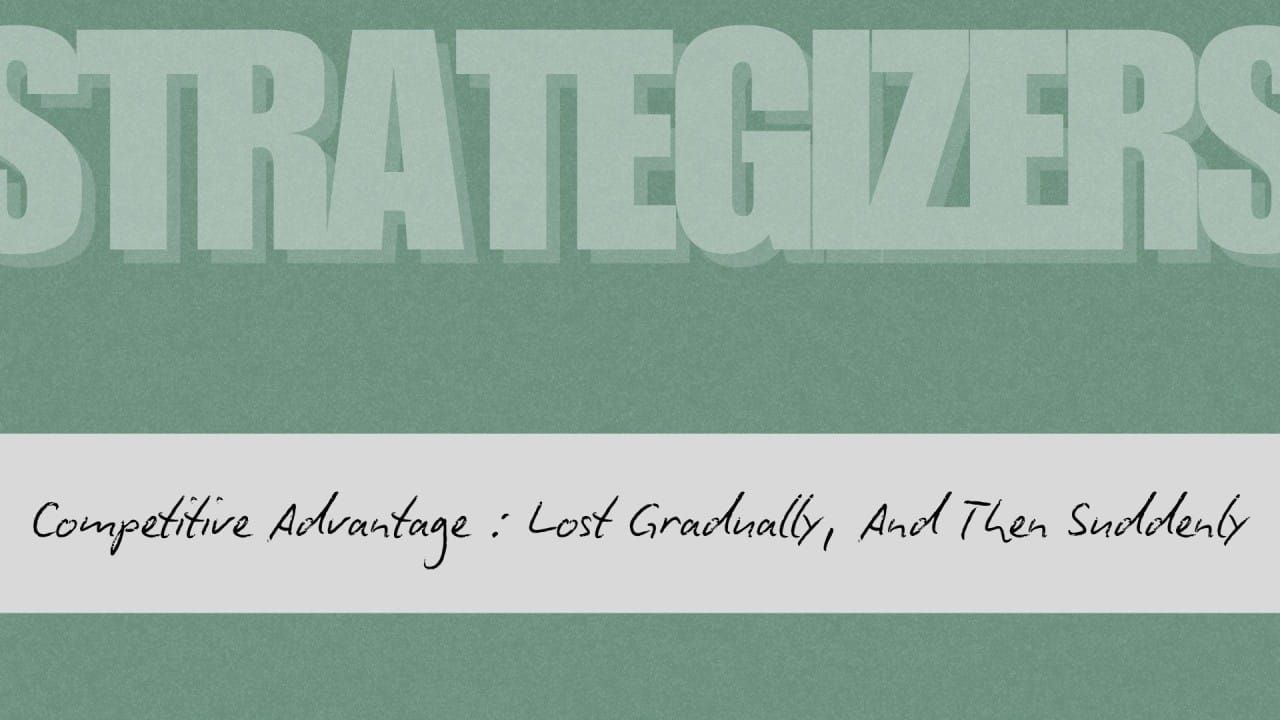
The researchers invoke a memorable line from Ernest Hemingway's The Sun Also Rises. When a character is asked how he went bankrupt, he answers: "Two ways. Gradually, and then suddenly." The same dynamic governs competitive advantage erosion. The signals are often present long before the crisis - they are simply not being monitored.
McKinsey's complementary research on competitive advantage erosion reveals that most companies aren't tracking the markers that would alert them to shifts underway. Despite widely recognizing that their advantage is not durable, they are not monitoring the signals that would tell them how and when it is changing. The result is a leadership posture that conflates historical performance with current competitive strength - a posture that feels like confidence but functions like complacency.
The data is stark. More than 40 percent of surveyed executives identify trends from outside their industry - new market entrants, technology players, non-traditional competitors - as the biggest threats to their competitive position. Only about a quarter believe the primary risk comes from existing peers simply outperforming them on current battlegrounds. This matters enormously: it means competitive advantage is not eroding along familiar lines. It is being disrupted from unexpected directions that traditional competitive monitoring frameworks are not designed to detect.
A Three-Source Convergence: The Problem Is Structural
What makes this finding more than just another cautionary data point is its convergence with parallel research from Harvard Business Review and Bain & Company - researchers arriving at the same structural conclusion from very different analytical angles.
A February 2026 HBR article by Sangeet Paul Choudary, a senior fellow at UC Berkeley and Thinkers50 Strategy Award recipient, illuminates a specific mechanism through which competitive advantage erodes invisibly: large incumbent organizations deploy new technologies, including AI, at scale, yet continue to lose ground to smaller challengers. The reason is that they use technology to optimize existing work rather than to rethink how work itself is organized. The technology is adopted. The architecture of the organization is not changed. The result is efficiency gains without competitive repositioning.
Choudary's insight is structural: the real competitive advantage of transformative technology lies in its ability to break work into smaller units and enable entirely new forms of coordination. This can make familiar strategies obsolete while unlocking wholly new ones. Yet incumbents - precisely because they have more to protect - tend to deploy new capabilities within old frameworks. They get marginal gains. Their challengers get category-level repositioning.
Bain's research on commercial excellence sharpens this further. In their 2025 B2B Commercial Excellence survey of 1,300 senior executives across 18 industries, Bain identifies a striking divergence in how winning and lagging companies perceive their challenges. Among top-performing firms - those in the upper quartile for revenue growth and gross margin - the primary concern is how to apply AI and machine learning effectively. Among lagging firms, the dominant worry is navigating market uncertainty and managing pricing pressure. Winners are focused on future competitive positioning. Laggards are focused on surviving current conditions.
The implication is pointed: by the time a company is fighting pricing pressure and market uncertainty, it has likely already lost the competitive initiative. The window in which strategic moves could have repositioned the company has already narrowed. The advantage eroded gradually - and then suddenly.
The Misplaced Confidence Problem
Return to the central paradox: how can leaders be confident about something they do not actually understand or validate?
Part of the answer lies in what confidence is typically anchored to. In my experience leading enterprise transformation, leaders most often build their sense of competitive strength on internal metrics - market share trends, revenue growth, customer satisfaction scores, operational efficiency indicators. These are real measures. But they are lagging indicators of competitive position, not leading ones. They tell you how well past advantages have delivered value. They do not tell you whether those advantages remain structurally intact.
McKinsey's research confirms this pattern. It finds that most companies still only track drivers of competitive advantage that are internal and operationally visible. Far fewer track the external, market-level signals that would indicate whether those advantages are being eroded by shifts in customer choice, new entrant positioning, or technology-enabled substitution.
The consequence is significant. Nearly two-thirds of the surveyed executives acknowledge that their organizations sometimes or often miss growth opportunities - launching new products, entering new markets - because competitors move first. Not because competitors had better capabilities. But because competitors were paying attention to the market signal while the organization was confident in its current position.
Seventy-nine percent of respondents expect their organizations will need to moderately or significantly change their business model within three years to remain economically viable. And yet: they are not actively validating whether their competitive advantage is still sound enough to fund that transition. They are planning transformation while operating on an unexamined assumption about the strength of the platform they are transforming from.
The Outperformer's Discipline
What separates organizations that sustain competitive advantage from those that gradually lose it?
McKinsey's research provides a precise answer. Top economic performers - defined as companies in approximately the top quintile for both organic revenue growth and EBIT - are more than 2.5 times as likely as peers to be fully aligned enterprise-wide on what their competitive advantages actually are. They are two-thirds more likely to be tracking that advantage at the market level, not just internally. And they are more than three times as likely as other respondents to report that their growth expectations have increased significantly across both their core and adjacent businesses.
The discipline of top performers is not mystical. It is methodical. They treat competitive advantage not as an inherited asset to be protected but as a dynamic hypothesis to be validated. They ask different questions: Not just "What are our strengths?" but "Why do customers choose us over alternatives in each specific market, and is that reason still holding?" Not just "What is our market share?" but "Is the shuffle rate in our industry accelerating, and what does that mean for how long our current position is sustainable?"
This posture is fundamentally different from strategic planning as most organizations practice it. It requires competitive intelligence to flow continuously, not annually. It requires leadership alignment on what advantage actually means at the business unit level, not just in the corporate narrative. And it requires the organizational courage to acknowledge when advantage is shifting - before the financial statements confirm it.
What I Saw in Enterprise Transformation
My work in enterprise transformation taught me something that these research findings confirm but do not fully capture: the organizational tendency to conflate confidence with understanding is not merely cognitive - it is structural.
Large organizations build governance processes, reporting systems, and planning cycles that are optimized to validate existing strategy rather than interrogate it. The quarterly business review is designed to track execution against plan, not to surface evidence that the plan's underlying assumptions have shifted. The annual strategic planning process typically starts from last year's strategic position, adjusted for market conditions, rather than from a zero-based examination of whether the competitive foundations still hold.
Large-scale transformation requires the capacity to surface what the formal system is not designed to see. Change agents that are not primarily there to execute change but to sense it - to detect, at the front lines of the organization and its markets, the early signals that strategic assumptions were shifting before those signals reached the executive level through normal reporting channels.
What the McKinsey, HBR, and Bain research collectively describes is the strategic equivalent of that sensing function: the capacity to monitor competitive advantage at the market level in real time, rather than relying on the lagging confidence of internal performance metrics. Organizations that build this capacity, that institutionalize market-level competitive intelligence as a discipline rather than an event, are the ones that move from the McKinsey survey's majority (confident but uninformed) to its outperformer minority (aligned and validated).
The AI Complication
The challenge of managing competitive advantage in 2026 is compounded by a specific AI dynamic that both the HBR and Bain research illuminate.
As the HBR research notes, many incumbent companies are aggressively deploying AI while seeing only marginal competitive gains, because they are using it to optimize existing work rather than to rethink their organizational architecture. This creates a dangerous illusion of strategic action: the organization is investing in transformation, activity is visible, and efficiency metrics improve - yet the structural basis of competitive differentiation remains unchanged or is eroding.
The BCG research on AI leadership identifies a parallel insight: only 15 percent of CEOs qualify as what BCG calls "trailblazers" - decisive AI champions who have upskilled nearly three-quarters of their employees and are systematically making AI a top priority at scale. The remaining 85 percent are investing in AI while capturing only marginal advantage from it. They are spending on transformation without repositioning.
The critical strategic implication: AI investment is not a substitute for competitive intelligence. An organization can deploy AI extensively and still fail to understand whether its underlying competitive advantage is holding. The technology accelerates execution; it does not automatically surface the market-level insights that tell you whether what you're executing is still the right thing to be doing.
Five Practices That Separate the Informed from the Confident
Drawing on the McKinsey research and these practitioner insights, five disciplines characterize organizations that actively manage - rather than passively assume - competitive advantage:
- Granular market-level tracking: Competitive advantage is not uniform across a company's markets. Top performers monitor it at the level of specific markets, customer segments, and geographies - not just at the enterprise level. This requires competitive intelligence functions that go beyond win/loss analysis to track structural shifts in customer choice criteria.
- Shuffle rate monitoring: Tracking how fast market leadership positions are changing in your industry - and what is driving that change - provides early warning of structural disruption that operational metrics will not show until it is too late.
- Non-traditional threat scanning: Given that more than 40 percent of executives identify outside-industry entrants as the primary competitive threat, strategic intelligence systems need to extend beyond traditional competitive analysis to monitor technology players, platform entrants, and adjacent industry moves. This includes tracking acquisitions by players outside the industry - McKinsey finds that top performers are more than 50 percent more likely to monitor such moves.
- Enterprise-wide alignment on advantage: Competitive advantage that only the C-suite understands is not operationally available. Top performers invest in ensuring alignment across all areas of the organization - not just on what the strategy is, but on what specific advantages underpin it. This is exactly the kind of alignment that transformation infrastructure - change agent networks, leadership forums, cascade communication - is designed to create.
- Bold moves anchored in advantage: The McKinsey research is clear that the highest-return growth moves are those that extend existing competitive advantage into adjacent markets or applications, rather than betting on wholly new capabilities. This requires knowing your advantages well enough to identify where they travel - which is impossible if those advantages are not being rigorously validated.
The Strategic Imperative
The convergence of McKinsey, Harvard Business Review, and Bain research tells a consistent story: competitive advantage in 2026 is neither as well understood nor as durable as most organizations assume. The executives who believe they understand their competitive position are often working from an internal, lagging picture of what past advantages have delivered - not a current, market-validated assessment of whether those advantages are intact.
The organizations that will sustain competitive differentiation through this period of accelerating change are not necessarily those with the strongest current advantages. They are those with the clearest, most grounded understanding of what their advantages actually are, the most rigorous systems for monitoring whether those advantages are holding, and the organizational alignment to move quickly when the evidence says they are not.
Confidence, in strategy, is only as valuable as the intelligence that grounds it. Without that grounding, confidence is not a strategic asset. It is a vulnerability dressed as one.
How does your organization validate its competitive advantage, and does your monitoring system reach the market level where erosion actually begins? I would welcome your perspective in the comments.