The Change Portfolio Approach: Managing Transformation Like an Investment
Your CFO wouldn't dream of managing the company's investment portfolio by launching every promising opportunity simultaneously, ignoring capacity constraints, and hoping for the best. Yet that's exactly how most organizations manage change.
Here is the uncomfortable truth: the average employee now experiences 10 enterprise-level changes simultaneously, up from just 2 in 2016. That's a 400% increase in change volume. Meanwhile, employee willingness to support change has collapsed from 76% to 38% in the same period. And 73% of organizations report being at or near the point of change saturation.
This isn't a change management problem. It's a portfolio management problem.
The Investment Portfolio You Already Understand
Every executive understands portfolio management for financial investments. You don't allocate 100% of capital to high-risk ventures. You balance your portfolio across risk profiles. You monitor correlation between assets. You rebalance when positions become overweight. You consider the portfolio's aggregate risk, not just individual investment risk.
Yet when it comes to organizational change, these same executives greenlight transformations as if each exists in isolation. ERP implementation? Approved. Agile transformation? Approved. Cloud migration? Approved. New data governance framework? Approved. Organizational restructuring? Why not.
What is missing is the holistic view. In financial portfolio management, you assess aggregate exposure. In change management, only 31% of employees report their organization prevents them from becoming overloaded by change. The math is not mathing.
Change Capacity: Your Organization's Capital
In financial terms, capital is finite. You can't deploy more than you have without leverage, and excessive leverage creates systemic risk. The same principle applies to organizational change capacity.
Change capacity is determined by several factors: organizational culture, change management competency, leadership bandwidth, employee resilience, and historical success with change. Research identifies change capacity and change disruption as the two critical variables that determine whether your organization can absorb transformation or will buckle under the load.
Think of change capacity like your organization's available investment capital. When change disruption - the volume and intensity of concurrent changes - exceeds this capacity, you have created the equivalent of an overleveraged portfolio. The result? Change saturation, where employee burnout, resistance, and initiative failure become inevitable.
The warning signs are everywhere. LinkedIn's 2024 survey found 64% of professionals feel overwhelmed by how quickly work is changing, and 68% are asking for more support. Yet organizations continue piling on initiatives, treating capacity as unlimited.
Why Your PMO Is Not Solving This
Most organizations have Project Management Offices that track initiatives. But traditional PMOs focus on project-level metrics - schedule, budget, scope - and not the aggregate impact on the organization's ability to absorb change. They inventory projects without assessing portfolio risk.
This is the equivalent of your CFO tracking individual stock performance without monitoring overall portfolio risk exposure. Each change initiative might be "on track" while the portfolio as a whole is careening toward disaster.
The critical gap: PMOs manage project delivery. Nobody manages the change portfolio. Organizations increasingly recognize the need for change portfolio management - holistic oversight that aligns initiatives with strategic objectives while ensuring resources are optimally allocated.
The Five Principles of Change Portfolio Management
1. Assess Your Total Exposure
Before approving any new transformation, conduct a portfolio-level assessment. What's the aggregate change load across the organization? Which business units are carrying the heaviest burden? Where are changes overlapping, creating compounding effects?
In an earlier role leading transformation across a large organization, we built visibility into the full change landscape. We didn't just track individual initiatives - we mapped their cumulative impact on each function, geography, and employee population. This enterprise view revealed hotspots where change saturation was creating real risk.
2. Calculate Risk-Adjusted Returns
Every transformation promises benefits. But what is the probability of realization given your current portfolio load? A high-value initiative launched into a saturated environment has a dramatically lower expected return than the same initiative launched when capacity exists.
This is where organizations consistently miscalculate. Research shows transformations focused on technology rather than strategy fail at alarming rates - not because the technology is wrong, but because the portfolio was already overextended.
3. Actively Rebalance
Investment portfolios require periodic rebalancing as positions drift from target allocations. Change portfolios need the same discipline. McKinsey research on corporate portfolio management found an optimal rotation rate - neither too static nor too aggressive. The same principle applies to organizational change.
This means having the courage to pause, postpone, or kill initiatives when the portfolio becomes unbalanced. It means prioritizing ruthlessly based on strategic value and organizational capacity, not political clout or sunk costs.
4. Manage Correlation Risk
In financial portfolios, correlation between assets determines aggregate risk. When everything moves together, diversification disappears. The same dynamic exists in change portfolios.
Multiple technology transformations hitting IT simultaneously. Several restructurings affecting the same business unit. Overlapping process changes requiring the same subject matter experts. These correlated changes create concentrated risk that individual project assessments miss entirely.
5. Build Organizational Muscle
The goal isn't to minimize change - it's to increase capacity. Organizations with strong change management capabilities experience 264% greater revenue growth than those with below-average change effectiveness.
This requires systematic capability building. Don't just execute transformations - build networks of change agents and engage senior leaders to create enduring change management infrastructure. Each transformation will leave the organization more capable of absorbing the next one.
The Emerging Solution: Change Management Centers of Excellence
Forward-thinking organizations are creating Change Management Centers of Excellence - permanent teams focused on long-term transformation portfolio management rather than borrowed resources cycling through individual projects.
These CoEs serve as the organizational equivalent of an investment committee. They maintain the holistic view. They assess aggregate risk. They make portfolio-level allocation decisions. They build organizational capacity systematically.
But here is the critical distinction: effective CoEs don't just coordinate change activities, they own the change portfolio strategy. They have authority to pause initiatives when capacity is constrained. They can sequence transformations to optimize absorption. They build the enterprise capability that makes continuous change sustainable.
What This Means for You
If you are a transformation leader, stop managing changes in isolation. Start thinking in portfolio terms:
- Map your current change portfolio. What is the full inventory of active transformations? Where is the change load concentrated?
- Assess your organization's change capacity honestly. Not aspirationally, realistically. What can your organization absorb given its current state?
- Identify correlation risk. Which changes are hitting the same populations? Where are dependencies creating amplified exposure?
- Establish portfolio governance. Who has the authority and accountability to make portfolio-level trade-offs?
- Build capacity systematically. Every transformation should leave your organization more capable of handling the next one.
The transformation landscape is not going to slow down. Prosci predicts the rate of change will continue climbing into 2025 as organizations accelerate change to stay competitive. The question isn't whether your organization will face a high volume of change. The question is whether you'll manage it like an overleveraged gambler or like a sophisticated portfolio manager.
The organizations that master change portfolio management won't just survive the transformation wave. They will ride it to competitive advantage while their competitors drown in change saturation.
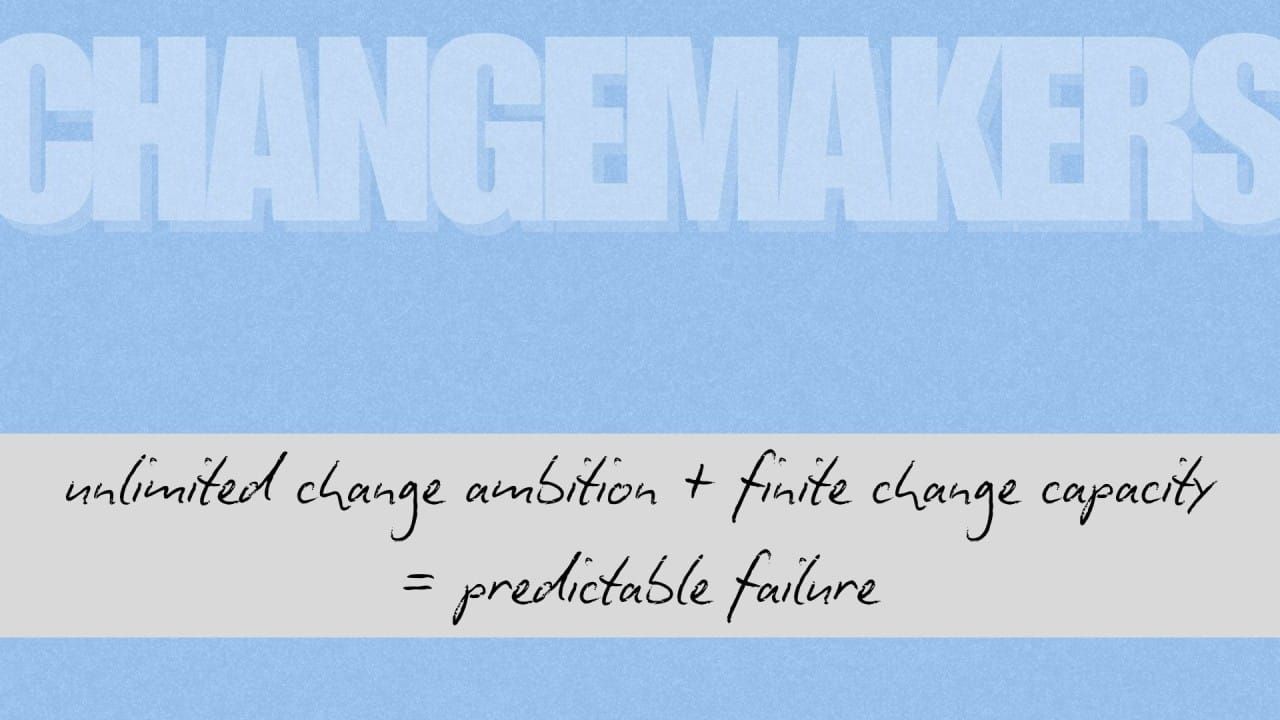
The math is simple: unlimited change ambition + finite change capacity = predictable failure. It's time to treat organizational change with the same portfolio discipline we apply to financial investments., ignoring capacity constraints, and hoping for the best. Yet that's exactly how most organizations manage change.
Here is the uncomfortable truth: the average employee now experiences 10 enterprise-level changes simultaneously, up from just 2 in 2016. That's a 400% increase in change volume. Meanwhile, employee willingness to support change has collapsed from 76% to 38% in the same period. And 73% of organizations report being at or near the point of change saturation.
This isn't a change management problem. It's a portfolio management problem.
The Investment Portfolio You Already Understand
Every executive understands portfolio management for financial investments. You don't allocate 100% of capital to high-risk ventures. You balance your portfolio across risk profiles. You monitor correlation between assets. You rebalance when positions become overweight. You consider the portfolio's aggregate risk, not just individual investment risk.
Yet when it comes to organizational change, these same executives greenlight transformations as if each exists in isolation. ERP implementation? Approved. Agile transformation? Approved. Cloud migration? Approved. New data governance framework? Approved. Organizational restructuring? Why not.
What is missing is the holistic view. In financial portfolio management, you assess aggregate exposure. In change management, only 31% of employees report their organization prevents them from becoming overloaded by change. The math is not mathing.
Change Capacity: Your Organization's Capital
In financial terms, capital is finite. You can't deploy more than you have without leverage, and excessive leverage creates systemic risk. The same principle applies to organizational change capacity.
Change capacity is determined by several factors: organizational culture, change management competency, leadership bandwidth, employee resilience, and historical success with change. Research identifies change capacity and change disruption as the two critical variables that determine whether your organization can absorb transformation or will buckle under the load.
Think of change capacity like your organization's available investment capital. When change disruption - the volume and intensity of concurrent changes - exceeds this capacity, you have created the equivalent of an overleveraged portfolio. The result? Change saturation, where employee burnout, resistance, and initiative failure become inevitable.
The warning signs are everywhere. LinkedIn's 2024 survey found 64% of professionals feel overwhelmed by how quickly work is changing, and 68% are asking for more support. Yet organizations continue piling on initiatives, treating capacity as unlimited.
Why Your PMO Is Not Solving This
Most organizations have Project Management Offices that track initiatives. But traditional PMOs focus on project-level metrics - schedule, budget, scope - and not the aggregate impact on the organization's ability to absorb change. They inventory projects without assessing portfolio risk.
This is the equivalent of your CFO tracking individual stock performance without monitoring overall portfolio risk exposure. Each change initiative might be "on track" while the portfolio as a whole is careening toward disaster.
The critical gap: PMOs manage project delivery. Nobody manages the change portfolio. Organizations increasingly recognize the need for change portfolio management - holistic oversight that aligns initiatives with strategic objectives while ensuring resources are optimally allocated.
The Five Principles of Change Portfolio Management
1. Assess Your Total Exposure
Before approving any new transformation, conduct a portfolio-level assessment. What's the aggregate change load across the organization? Which business units are carrying the heaviest burden? Where are changes overlapping, creating compounding effects?
In an earlier role leading transformation across a large organization, we built visibility into the full change landscape. We didn't just track individual initiatives - we mapped their cumulative impact on each function, geography, and employee population. This enterprise view revealed hotspots where change saturation was creating real risk.
2. Calculate Risk-Adjusted Returns
Every transformation promises benefits. But what is the probability of realization given your current portfolio load? A high-value initiative launched into a saturated environment has a dramatically lower expected return than the same initiative launched when capacity exists.
This is where organizations consistently miscalculate. Research shows transformations focused on technology rather than strategy fail at alarming rates - not because the technology is wrong, but because the portfolio was already overextended.
3. Actively Rebalance
Investment portfolios require periodic rebalancing as positions drift from target allocations. Change portfolios need the same discipline. McKinsey research on corporate portfolio management found an optimal rotation rate - neither too static nor too aggressive. The same principle applies to organizational change.
This means having the courage to pause, postpone, or kill initiatives when the portfolio becomes unbalanced. It means prioritizing ruthlessly based on strategic value and organizational capacity, not political clout or sunk costs.
4. Manage Correlation Risk
In financial portfolios, correlation between assets determines aggregate risk. When everything moves together, diversification disappears. The same dynamic exists in change portfolios.
Multiple technology transformations hitting IT simultaneously. Several restructurings affecting the same business unit. Overlapping process changes requiring the same subject matter experts. These correlated changes create concentrated risk that individual project assessments miss entirely.
5. Build Organizational Muscle
The goal isn't to minimize change - it's to increase capacity. Organizations with strong change management capabilities experience 264% greater revenue growth than those with below-average change effectiveness.
This requires systematic capability building - through networks of change agents and engaged senior leaders - to create enduring change management infrastructure. Each transformation will leave the organization more capable of absorbing the next one.
The Emerging Solution: Change Management Centers of Excellence
Forward-thinking organizations are creating Change Management Centers of Excellence - permanent teams focused on long-term transformation portfolio management rather than borrowed resources cycling through individual projects.
These CoEs serve as the organizational equivalent of an investment committee. They maintain the holistic view. They assess aggregate risk. They make portfolio-level allocation decisions. They build organizational capacity systematically.
But here is the critical distinction: effective CoEs don't just coordinate change activities, they own the change portfolio strategy. They have authority to pause initiatives when capacity is constrained. They can sequence transformations to optimize absorption. They build the enterprise capability that makes continuous change sustainable.
What This Means for You
If you are a transformation leader, stop managing changes in isolation. Start thinking in portfolio terms:
- Map your current change portfolio. What is the full inventory of active transformations? Where is the change load concentrated?
- Assess your organization's change capacity honestly. Not aspirationally, realistically. What can your organization absorb given its current state?
- Identify correlation risk. Which changes are hitting the same populations? Where are dependencies creating amplified exposure?
- Establish portfolio governance. Who has the authority and accountability to make portfolio-level trade-offs?
- Build capacity systematically. Every transformation should leave your organization more capable of handling the next one.
The transformation landscape is not going to slow down. Prosci predicts the rate of change will continue climbing as organizations accelerate change to stay competitive. The question isn't whether your organization will face a high volume of change. The question is whether you'll manage it like an overleveraged gambler or like a sophisticated portfolio manager.
The organizations that master change portfolio management won't just survive the transformation wave. They will ride it to competitive advantage while their competitors drown in change saturation.
The math is simple: unlimited change ambition + finite change capacity = predictable failure. It's time to treat organizational change with the same portfolio discipline we apply to financial investments.
How many enterprise-level changes is your organization currently managing? Do you have a comprehensive view of your change portfolio, or are you tracking initiatives in isolation? What percentage of your organization's change capacity is currently consumed? Share your perspectives in the comments.