AI Doesn’t Give You an Edge. It Reveals Whether You Had One.
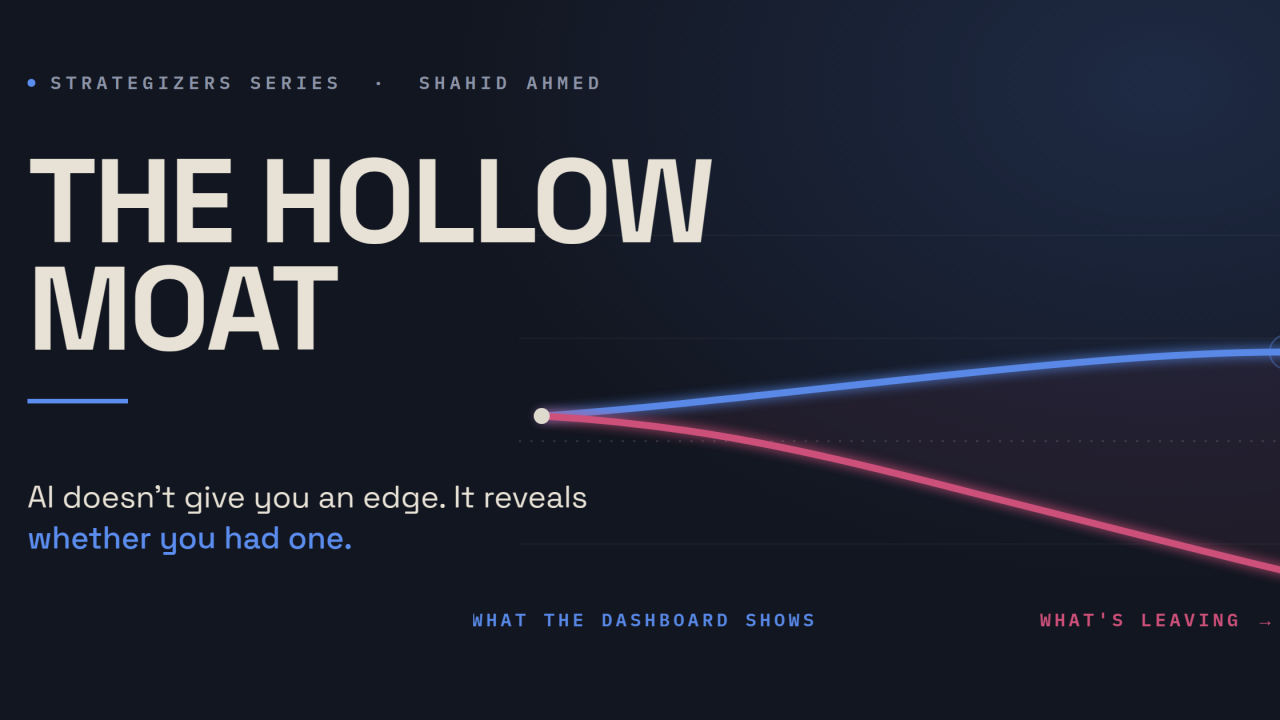
Somewhere in your industry right now, a company’s dashboards look healthy. Revenue is holding. Market share is stable. Customer retention is on plan. And its most profitable business is quietly being dismantled.
This is the dynamic that should be keeping strategists awake in 2026, and it has a name. Boston Consulting Group calls it hollowing: the condition in which revenue, share, and retention all look intact while the economic substance beneath them - margin and pricing power - drains away. The moat looks solid from the inside at precisely the moment it is being crossed from the outside.
We have spent two years asking the wrong question about AI. The question executives keep posing is some version of “how do we adopt it?” The question the latest research insists we ask instead is colder: does AI strengthen the advantage we actually have - or is it hollowing it out while our metrics reassure us? Because AI, it turns out, is not a strategy. It is an amplifier. And amplifiers work in both directions.
The Amplifier Cuts Both Ways
BCG’s recent analysis of how AI is rewriting competitive advantage opens with a historical analogy worth revisiting. Every technological revolution begins with the illusion that we are watching a single story. The railways of the 1870s looked like a story about transportation; they became one about land, capital markets, and national development. The internet looked like a story about retail and telcos; it became one about the collapse of newspapers and the rise of platform monopolies. AI in 2026 looks like a story about productivity. It will turn out to be a story about where value pools migrate - and who captures them.
The scale of the capital reallocation underneath this has no modern parallel. Hyperscaler capital expenditure is on track for $750 billion in 2026 alone, and more than 65% of S&P 500 companies now reference AI on their earnings calls. But the more revealing number is the destruction, not the spend. Roughly $2 trillion in market value has already been wiped off legacy enterprise software companies whose subscription moats once looked impregnable. Markets are not waiting for the disruption to show up in earnings; they are pricing it in advance.
That is the first uncomfortable truth. The market is already writing a story about whether your company wins or loses in this transition, and it is doing so ahead of your own P&L. If your multiple has compressed relative to your sector, the buy-side has quietly cast you as a loser in the redistribution. Most leadership teams have not read the verdict, let alone decided whether to contest it. BCG identifies five structural factors - task substitutability, market concentration, data defensibility, compute intensity, and regulatory friction - that determine, sector by sector, whether the AI dividend accrues to shareholders, gets competed away to customers, or leaks out entirely to the new compute layer sitting in everyone’s cost base. The same technology produces opposite outcomes depending on the rules of the game.
BCG’s companion study of AI adoption leaders supplies the empirical spine of the argument. Examining companies that have genuinely scaled AI across technology, talent, and deployment, the researchers found a striking exception: a minority of these high-adoption leaders are nonetheless losing - posting declining margins and growth despite doing everything right on the technology. The reason is not their AI. It is that they sit on commoditized offerings or business models already displaced by digitally native rivals. The conclusion is worth stating flatly, because it inverts the prevailing narrative: AI amplifies a strong strategy; it does not substitute for one.
I have watched versions of this play out long before AI made it acute. The most sophisticated tools in the world, dropped into an organization with no defensible position, simply help it reach the wrong destination faster. Technology has never been a strategy. It has always been a multiplier of one - and, just as reliably, a multiplier of its absence.
The Moats That Deepen - and the Ones That Only Feel Permanent
If AI amplifies position, the decisive act of strategy becomes brutally specific: knowing which of your advantages AI is strengthening and which it is silently eroding.
BCG offers a map for this, sorting advantages along two axes - the depth of the protective moat, and its durability under AI. The advantages in the strong quadrant share a common logic: they compound with use and deepen with scale, becoming more valuable precisely because AI raises the cost of replicating them from scratch. Flow data - the continuous stream a product generates, feeding models that improve it - is the clearest example; Visa’s network processes more than 257 billion transactions a year, each one sharpening fraud and authorization models a competitor cannot recreate. Trusted relationships, network scale, scarce physical assets, and deep system-level integration sit in the same quadrant. AI makes them stronger.
The dangerous quadrant is the other one - the advantages that feel permanent from the inside while eroding from the outside. Proprietary knowledge and expertise. Static datasets. Operational excellence. For a generation these were the sources of durable edge. They are also precisely what AI commoditizes fastest, because the same foundation models and inference economics are available to everyone, and the underlying technology converges toward rough parity within two to three years. An advantage built on knowing something others don’t, or on running a process better than others can, is now on a clock.
Here is where I would press on the research rather than simply relay it. The map is analytically clean, but it describes a static snapshot of advantages an organization already holds. The harder question - the one I spent years living inside - is whether an organization can tell the difference in time and act on it, given that the honest answer implicates people, budgets, and businesses that leaders are emotionally and politically invested in. Auditing your own moats is not a spreadsheet exercise. It is an act of institutional honesty that most organizations are structurally built to avoid. The advantages that “only feel permanent” feel that way for a reason: careers, incentives, and identities are constructed on top of them. The research names the quadrant. It understates how hard it is to look squarely at it.
The Attacker You’re Not Watching
The most instructive part of BCG’s analysis is its portrait of the AI-native attacker, because it dismantles a comforting assumption. The standard incumbent playbook assumes a new entrant will do what you do, only cheaper, to take your market share. That is not the threat. The dangerous attacker isolates the single highest-margin layer of your value chain, delivers it as a standalone product, and leaves you the low-margin remainder. It competes for your margin, not your revenue - which is why your competitor dashboard, built to track share, never sees it coming.
The examples predate AI but illustrate the mechanism exactly. In banking, Chime owns the customer relationship and interchange economics while chartered banks hold the low-margin deposits and infrastructure beneath. In retail, the media network that controls what a shopper sees extracts advertising margins of 70 to 90 percent, while the retailer fulfills the actual product for low single digits. AI now runs the same play at speed: platforms that optimize equipment they didn’t build in order to capture the aftermarket service margin; customer-service agents that resolve interactions autonomously and charge per successful resolution rather than per seat, competing for the margin inside the resolution itself.
The instinct a corporate-development background trains is to look past revenue to where margin actually lives - and it is exactly that instinct most operating dashboards lack. Leaders watch the top line and the share number because those are the instruments on the panel. The attacker is deliberately competing on a dimension the panel doesn’t display.
And here BCG names something every transformation leader should underline. The attacker’s structural advantage is organizational, not technological. A company built from scratch around AI-era economics carries no embedded headcount, no committed real estate, no inherited workflow. Bolting AI onto a legacy operation closes only part of the gap, because the edge comes from architecture and talent, not from tools. You cannot buy your way to parity with a purchase order. This is the sentence the whole strategy conversation has been circling without landing on: the incumbent’s vulnerability is not a technology deficit. It is an organizational one.
Why the Bottleneck Was Never the Technology
Which returns us to what actually determines who wins. BCG is unambiguous that the bottleneck to executing an AI strategy is rarely the technology - it is talent, workflows, and culture, and the incumbents that struggle will not be the ones that lacked the tools but the ones whose organization could not metabolize them. McKinsey’s State of Organizations 2026 puts a number on the same truth: this is a double transformation, technical and organizational at once, and technology adoption without organizational transformation yields diminishing returns. Their rule of thumb is that for every dollar spent on AI technology, an organization should invest five in its people.
I would go further than the ratio, because I have lived the denominator. That “five dollars in people” is not a training budget – its an investment in infrastructure: a network of change agents embedded in the businesses, senior leaders explicitly accountable for carrying strategic meaning into their organizations - and for pushing distortion back up the chain when the strategy does not survive contact with their reality. That apparatus is needed because moving an enterprise is not a matter of communication. It is a matter of building the capacity to change as a standing capability rather than a one-time program.
McKinsey also observes that two-thirds of leaders now admit their organizations are too complex, and that the traditional remedies - structural redesigns, cost cuts, flatter hierarchies - are delivering diminishing returns. That finding should land harder than it does. It means the reflexes most executives reach for when they need to move fast are the very ones that no longer work. The muscle that matters now is not redrawing the boxes. It is the ability to rewire how work actually flows - and to do it repeatedly, across markets that refuse to behave the same way. Running P&L across Singapore, Malaysia, and Cambodia taught me that an operating model built for standardization breaks the moment it meets genuine local difference; what travels is the capability to reconfigure, not the configuration itself. That lesson is about to be tested at AI speed.
Transformation Capacity Is the New Moat
Put these threads together and a conclusion emerges that the individual reports gesture toward but none quite states.
If AI amplifies strategic position, if durable advantage migrates to assets that compound with scale, and if the AI-native attacker’s true edge is organizational rather than technological - then the incumbent’s single most important defensive asset is not any one moat on BCG’s map. It is the capacity to rearrange its moats at speed. The ability to shed legacy structure, redeploy capital and talent decisively, and move a large organization at something closer to founder pace is itself the competitive advantage now. BCG urges leaders to think like a founder, not a steward. I would add that founder-thinking without founder-infrastructure is merely an aspiration. The organizations that can act on it are the ones that built the transformation muscle during the easy years - when they didn’t obviously need it.
This is the quiet divide opening beneath the AI race. In the end it will not separate the companies with the best models from those without them; adoption is converging toward parity, and models are becoming a commodity input. It will separate the organizations that can metabolize change from the ones that assumed they could buy that capability when the moment came - and discover, when an attacker finally surfaces on the P&L, that transformation capacity is the one advantage you cannot acquire on demand.
The moat, in other words, is no longer what you own. It is how fast you can rearrange what you own. That was never a technology question. It never will be.
We keep asking whether our AI is good enough. How honestly are we asking whether our organization can move fast enough to use it - and which of those two questions is harder for you to answer?