Why Your AI Transformation Is Failing (And It's Not the Technology)
We're witnessing an unprecedented wave of AI adoption across enterprises. Two-thirds of global companies are now deploying generative AI. Yet despite massive investments and executive enthusiasm, most organizations are struggling to extract meaningful value from these technologies.
The problem isn't the AI. It's the change management.
The Fatal Assumption
I've observed this pattern repeatedly: leadership teams acquire cutting-edge AI tools, roll them out to employees, and expect transformation to follow. But as McKinsey's latest research on AI change management reveals, simply putting technology into people's hands doesn't ensure they'll use it effectively—and it certainly won't fundamentally change how your company operates.
The disconnect is staggering. Employees are already using AI three times more than their leaders realize, yet this grassroots experimentation isn't translating into organizational value. Why? Because we're treating AI like previous enterprise software implementations when it requires an entirely different approach.
Change Management Must Evolve
Traditional change management frameworks were built for a different era - one where technology was a tool to be deployed rather than a capability to be cultivated. Gen AI demands that we rethink this paradigm entirely.
The most successful AI transformations I've studied share a common characteristic: they transform employees from passive users into active participants. This means creating environments where people experiment, co-create solutions, and commit to continuous learning. It's messy, non-linear, and fundamentally different from the top-down implementations we're accustomed to.
The Participation Imperative
Here's a sobering statistic: in typical transformations, only 2% of employees are directly involved in the effort. Yet organizations that engage at least 7% of their workforce double their chances of delivering positive returns. The highest performers? They involve 21-30% of their people.
This participation gap is even more critical with AI because the technology's capabilities are still evolving rapidly. No single team - not IT, not the C-suite, not external consultants - has all the answers. Your frontline employees are discovering novel applications and use cases that nobody anticipated. The question is: are you capturing and scaling those insights?
The Middle-Out Advantage
One of the most intriguing findings from recent research is that millennial managers (ages 35-44) are emerging as AI's most enthusiastic adopters, with 62% reporting high expertise levels compared to just 22% of baby boomers. This suggests that successful AI adoption may not follow the traditional top-down cascade model.
Instead, we're seeing a middle-out approach where these digitally-native managers become change champions, mentoring both their teams and senior leadership. Organizations that identify and empower these superusers create powerful multiplier effects across the enterprise.
Two Paths Forward
As AI capabilities mature, I believe we'll see organizational structures evolve in two distinct directions:
Minimally Viable Organizations (MVOs): Certain functions - particularly those handling repetitive, logic-based work - will become extremely lean, highly automated workflows managed by small teams of specialized AI operators. Think invoice processing, basic data analysis, or routine compliance checks.
Augmented Teams: Other functions, especially those requiring human judgment, creativity, or relationship-building, will remain human-led but dramatically enhanced by AI. A single salesperson equipped with AI superpowers can manage larger portfolios with higher conversion rates. Customer service representatives can resolve issues faster while maintaining the human touch that builds loyalty.
The strategic question every leader must answer: which parts of your organization should become MVOs, and which should remain augmented teams?
Building the Foundation for Success
Successful AI transformations don't happen by accident. They require deliberate effort across several dimensions:
Trust through transparency: Organizations that invest in trust-enabling activities - robust governance, clear data policies, explainable AI outputs - see dramatically higher adoption rates. When Morgan Stanley deployed its AI assistant, they achieved 98% adoption by wealth management teams precisely because they invested in rigorous quality frameworks before rollout.
Workflow reimagination: Bolting AI onto existing processes delivers incremental impact at best. Real transformation requires putting AI at the center of workflows and completely reconfiguring how work happens. This demands deep collaboration between business and technology teams working together in two-in-the-box arrangements.
Skills at scale: Companies that provide formal AI training see significantly higher usage rates as employee confidence grows. But training alone isn't enough - AI must be woven into daily workflows so it becomes a habit, not a hobby.
The Leadership Challenge
The executives who will win in the AI era aren't those who deploy the most sophisticated models. They're the ones who successfully mobilize their people to embrace fundamentally new ways of working.
This requires courage to abandon playbooks that worked for previous technology waves. It demands patience as adoption unfolds unevenly across the organization. And it necessitates vulnerability—leaders must be willing to learn alongside their teams rather than pretending to have all the answers.
Most importantly, it requires viewing AI not as a tool to be managed but as a capability to be cultivated across the entire workforce.
The Bottom Line
AI's promise is extraordinary: freed from tedious tasks, equipped with powerful capabilities, your people could achieve outcomes that seem impossible today. But this future won't arrive simply because you've purchased the right technology.
It will arrive when you've transformed your organization's capacity for change itself—when experimentation is encouraged, when employees are empowered to redesign their own workflows, and when AI becomes an invisible but indispensable teammate.
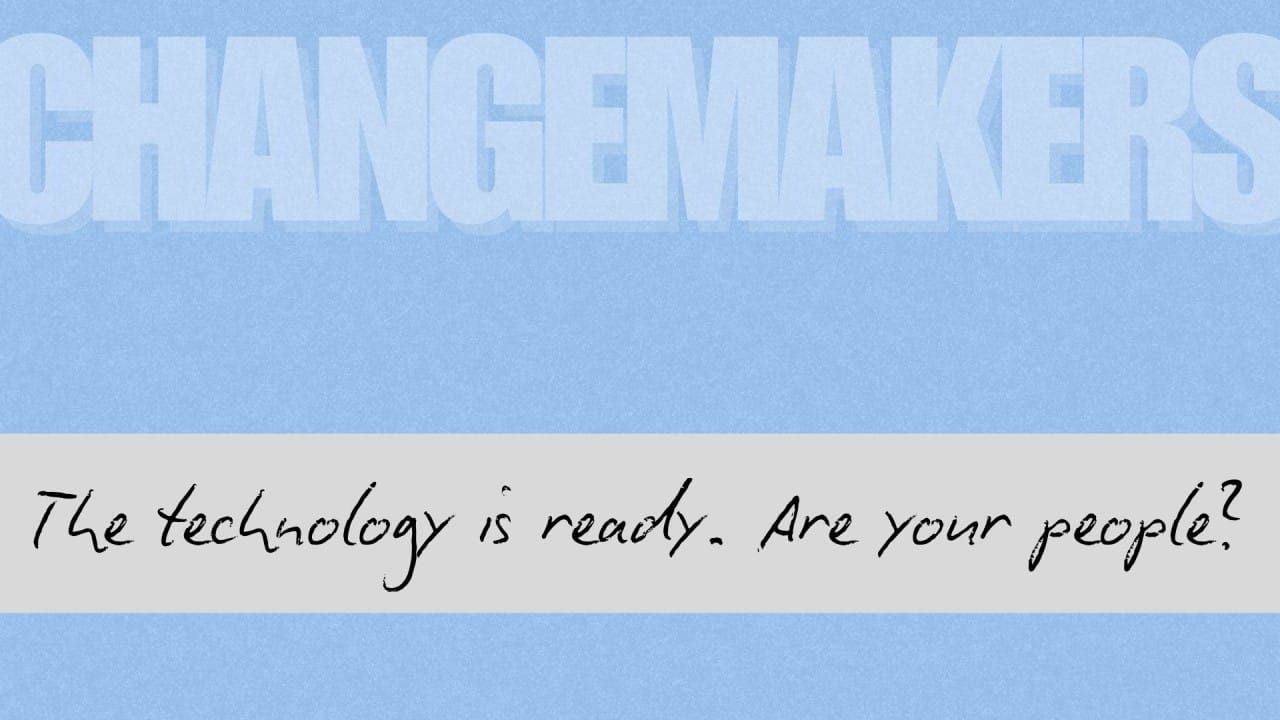
The technology is ready. The question is: are your people?
What's your experience with AI adoption in your organization? Are you seeing the participation gap in your transformation efforts? I'd welcome your perspectives in the comments.